
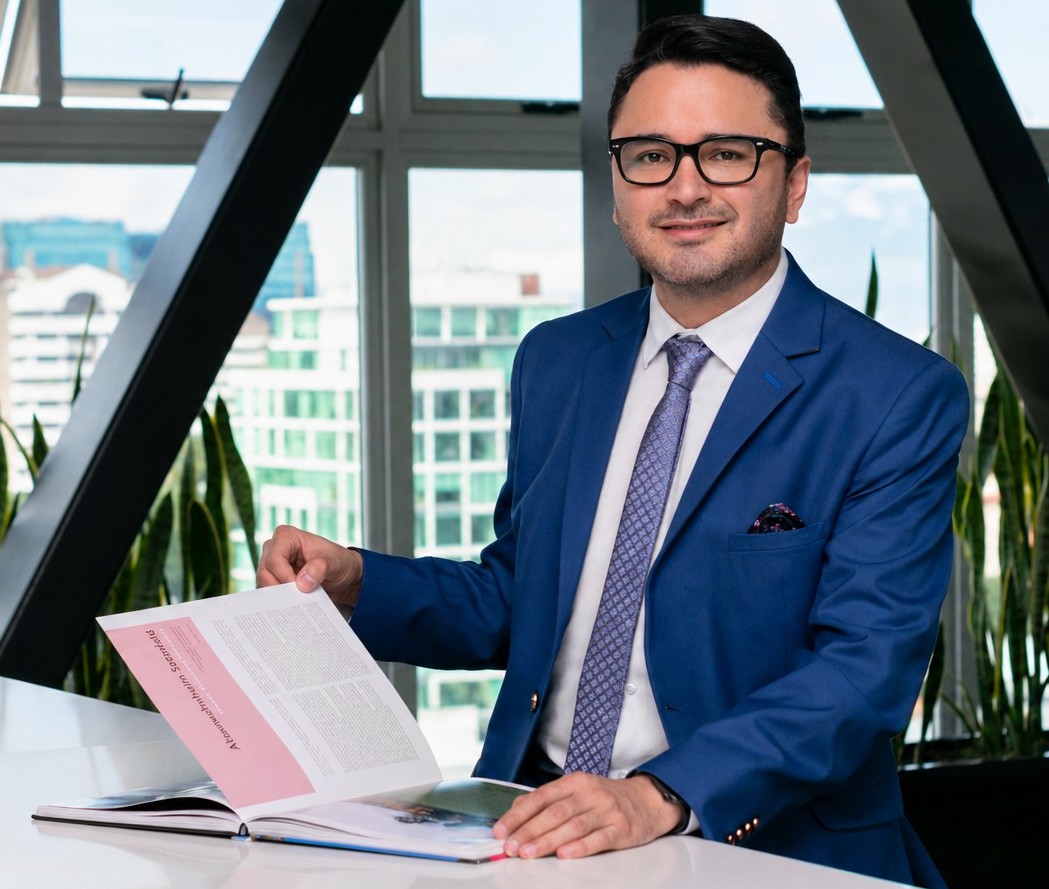
Published on: 31.08.2026 | Interview with: René Javier Vargas
"My biggest concern is the normalization of hollow democracies"
René Javier Vargas on social divides, democratic erosion, and the future of Mexico and Guatemala
1. How would you describe the main social divides in Mexico and Guatemala today?
I would say the deepest divide is not necessarily ideological, but territorial and economic: who has real access to the state and who does not. In Mexico, there is a clear contrast between the industrialized north and central regions and the poorer, more rural and Indigenous south. In Guatemala, that gap is even sharper: Guatemala City and a few urban centers coexist with rural and predominantly Indigenous territories where access to education, healthcare, infrastructure and formal employment remains extremely limited. In both countries, geography almost functions as a class system.
2. What are the biggest structural challenges facing the Mexican and Guatemalan economies right now?
Mexico's main challenges are low productivity, labor informality, insecurity, weak rule of law, pressure on public finances and bottlenecks in energy, water and infrastructure. It also remains highly dependent on its economic relationship with the United States.
Guatemala's case is different. It has maintained relatively strong macroeconomic stability, but it has not been able to transform that stability into broad-based development. The country collects very little in taxes, invests too little in infrastructure and human capital, and remains heavily dependent on informality and remittances. Guatemala's greatest contradiction is that it is stable on paper, but profoundly unequal in practice.
3. How would you assess the state of democratic institutions in Mexico under the current administration?
Mexico remains an electoral democracy, but its system of checks and balances has clearly weakened. Elections still matter, the opposition still governs important territories, and civil society and the media remain active. However, the concentration of power around Morena, the elimination or weakening of autonomous institutions and the judicial reform have reduced institutional counterweights.
The 2025 judicial election gave the reform formal legitimacy, but with roughly 13% turnout, it did not necessarily provide strong social legitimacy. Claudia Sheinbaum's style is more technical and disciplined than López Obrador's, but the institutional direction is largely one of continuity. Still, the failure of her original electoral reform in Congress also showed that political pluralism has not disappeared completely.
4. What are the main drivers of instability or state weakness in Guatemala?
The problem is not that Guatemala lacks laws or institutions; it is that they are applied selectively. The main drivers are low tax capacity, weak state presence outside the major urban centers, a fragmented party system, corruption, impunity and the politicization of parts of the justice system.
Governments change, but many of the networks operating through Congress, municipalities, public procurement, customs and the judicial system remain. Guatemala often has a state that is weak when it comes to delivering public services, but surprisingly strong when it comes to protecting entrenched interests or punishing those who challenge them.
5. How do organized crime and corruption intersect with formal politics in both countries?
Organized crime and corruption should not be seen as two separate worlds. Corruption creates the conditions that allow criminal organizations to operate, while criminal money and violence distort formal politics.
In Mexico, this is especially visible at the municipal and state levels, where criminal groups can intimidate candidates, influence police forces, control territory and obtain protection from local authorities. In Guatemala, the relationship is often less visible but more embedded in networks involving illicit campaign financing, contraband, public contracts, political operators and parts of the justice system. That does not mean every politician or institution is compromised, but the overlap is significant enough to weaken democracy in both countries.
6. Looking ahead five years, what is your biggest hope and your biggest concern for the region?
My biggest hope is that a younger and less traditionally partisan generation will demand better public services, greater transparency and more accountable institutions. Economic integration, technology and nearshoring could also create real opportunities if governments are capable of turning investment into inclusive development.
My biggest concern is the normalization of hollow democracies: countries where elections continue to take place, but independent institutions, accountability and territorial control gradually disappear. Democratic erosion in Latin America is unlikely to arrive through traditional coups. It will probably happen through legal reforms, popular leaders and authoritarian shortcuts presented as solutions to insecurity and institutional paralysis.
7. What do people associate Bulgaria and Bulgarians with in Mexico and Guatemala?
The honest answer is that Bulgaria does not have a very defined image in either country. In Mexico, older football fans may remember Hristo Stoichkov and Bulgaria's elimination of Mexico in the 1994 World Cup. More informed audiences may associate Bulgaria with Sofia, rose oil, yogurt, the Cyrillic alphabet or its post-communist history.
In Guatemala, the associations are even more general, and Bulgaria is often simply placed within the broader idea of Eastern Europe. I do not think there is a negative perception; rather, there is limited knowledge. That also represents an opportunity for greater cultural, academic and commercial exchange.
8. Do you have a favorite Mexican politician or historical figure? If yes, why?
I would probably choose Benito Juárez. Not because I believe his legacy should be romanticized or placed beyond criticism, but because he represents the effort to build a secular republic governed by institutions rather than inherited privilege. His Indigenous Zapotec background also makes his place in Mexican history particularly significant.
What interests me most is the tension between Juárez as a historical figure and Juárez as a national symbol. That tells us a great deal about how Mexico constructed its political identity.
9. What is a cultural tradition or celebration in Mexico that you think foreigners misunderstand or do not know enough about?
Día de Muertos is probably the clearest example. Foreigners often interpret it as a Mexican version of Halloween or as evidence of a cultural fascination with death. In reality, it is much more about memory, family and the continuing relationship between the living and those who have died.
It also varies greatly across regions and communities, combining Indigenous, Catholic and local traditions. The commercial version seen abroad is visually attractive, but it often loses the intimate and deeply personal meaning of the celebration.
10. What is a common stereotype about Mexico that you would like to correct?
The stereotype I would correct is that Mexico can be reduced to cartels, violence and migration. Those problems are real and should not be minimized, but Mexico is also a major industrial economy, a cultural power and an extraordinarily diverse federal country.
Violence is also highly territorial: the reality of one state or municipality cannot automatically be applied to the entire country. Mexico should neither be romanticized nor reduced to its worst problems.
11. What is something surprising most people outside the region do not know about Mexico or Guatemala?
Many people do not realize the extraordinary level of diversity within both countries. Guatemala officially recognizes 25 languages, including 22 Mayan languages, Xinka, Garífuna and Spanish. Mayan culture is not simply an archaeological legacy; it is a living political, linguistic and cultural reality.
Mexico, meanwhile, is far more regionally diverse and economically sophisticated than its international image often suggests. These are societies where modern industry, global integration and ancient cultural identities coexist every day.
12. If you had to recommend one book, film or artist to someone wanting to understand Mexico better, what would it be?
I would recommend La dictadura perfecta, directed by Luis Estrada. It is a political satire, not a documentary, but it captures the relationship between media, image management, corruption and political power in a way that remains extremely useful for understanding Mexico.
As someone with a background in both political science and marketing, I find it especially interesting because it shows that political power is not based only on institutions or ideology. It is also built through narratives, perception and control of the public agenda.
Questions asked by Dr. Dimitar Keranov