

Published on: 19.10.2026 | Author: Andrii Akymenko, Dr. Dimitar Keranov
Bulgaria and Ukraine: A Peaceful and Prosperous Economic Future for the Black Sea
Andrii Akymenko, Centre for Economic Strategy
Dr. Dimitar Keranov, Bulgarian Institute for International Politics
The recent drone attacks on commercial vessels off Bulgaria’s Black Sea coast are another reminder that Russia’s war against Ukraine is no longer a distant security concern for Bulgaria. On October 6, two merchant ships were attacked in Bulgaria’s exclusive economic zone, leaving one vessel sunk and another severely damaged. The incident raises important questions about the security and economic future of the entire Black Sea region.
The attacks did not stop there. On October 13, another ship sank off the Bulgarian coast, and the crew of a damaged Ukrainian-owned vessel was evacuated to the port of Varna. In October alone, drones have struck at least seven cargo ships off the coasts of Bulgaria and Romania. Sofia has not formally named the attacker, but Prime Minister Rumen Radev has said there is no logic in Ukraine attacking its own ships and that the outcome favors Russia. Bulgaria summoned the Russian ambassador and has formally asked NATO to deploy combat aircraft and anti-drone systems.
These strikes target shipping along the coasts of two NATO members. Making these waters dangerous and expensive can achieve much of what a naval blockade would. Radev himself has warned that the attacks drive up insurance costs and make shipping extremely difficult. For a port city like Varna, this is a direct economic risk.
Yet, while the war continues to threaten regional stability, Bulgaria and Ukraine have been developing increasingly important economic ties. In fact, the two countries have become more important trading partners than many might expect.
In 2025, trade in goods between Bulgaria and Ukraine reached €1.5 billion, exceeding Bulgaria’s trade with Russia by almost 11%. Ukraine overtook Russia among Bulgaria’s major trading partners in 2024 for the first time since 2006.
Chart Bulgarian partners, total bilateral trade in goods
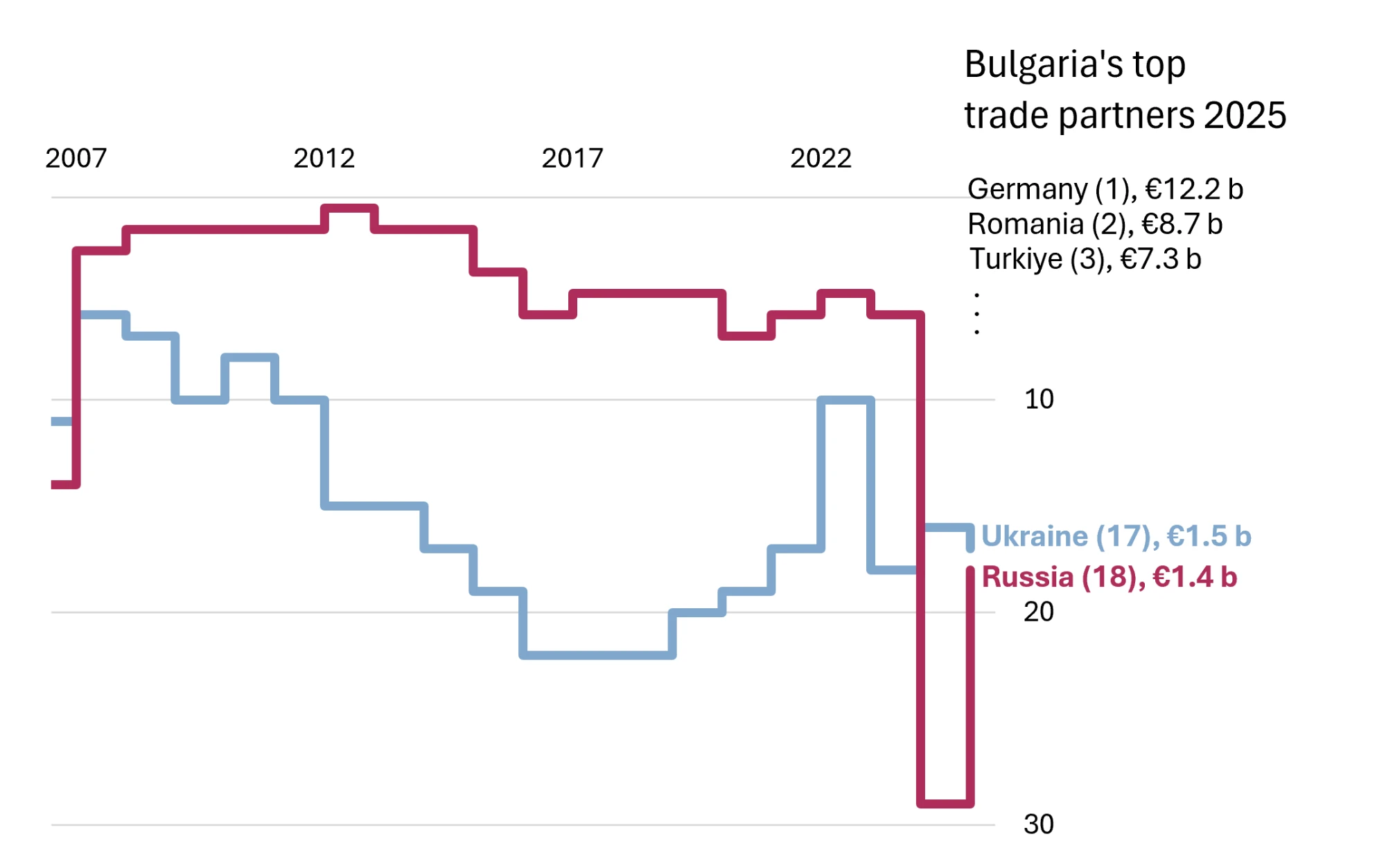
Source: Own representation based on the Eurostat
These changes are particularly relevant for Varna and the Bulgarian Black Sea coast.
In recent years, fertilizers have become Bulgaria’s main exports to Ukraine, reaching €180 million in 2025. Bulgaria has partly replaced Russia and Belarus in the Ukrainian fertilizer market, while Ukraine purchased three quarters of Bulgaria’s mixed fertilizer exports.
This trade supports Bulgaria’s domestic industry, including Agropolychim in Varna province, which employs around 750 people and is connected to an even broader network of suppliers, customers, and businesses at the nearby port and beyond. Bulgarian fertilizers, in turn, support Ukrainian agricultural production, contributing to food security across the region.
Ukraine also remains an important supplier of steel products to Bulgaria, traditionally accounting for most Bulgarian imports of certain steel categories. Despite the destruction caused by the war, bilateral trade has continued to diversify, with Bulgaria increasing imports of Ukrainian agricultural products, including vegetable oils, maize, and sugar.
Economic ties between the two countries go well beyond trade.
As of mid-2026, approximately 76,000 Ukrainians remained under temporary protection in Bulgaria, with a particularly strong presence along the Black Sea coast. Around 17,000 lived in Varna province alone.
These people are not only refugees but also employees, entrepreneurs, consumers, and members of local communities. Together with Ukrainian tourists, they spent approximately €260 million in Bulgaria in 2024 on accommodation, goods, and other personal expenses, supporting local businesses and the tourism sector.
For Varna and other coastal cities, the Ukrainian community represents an opportunity to strengthen economic and personal connections across the Black Sea, including with neighboring Romania.
Varna also has a role in the response. Together with Constanța, it is set to co-host the Black Sea Maritime Security Hub, whose joint concept Bulgaria and Romania presented to EU foreign ministers in June 2026. The hub is meant to improve joint risk analysis and the protection of critical maritime infrastructure. The recent attacks are a strong argument for moving it quickly from concept to practice.
The Black Sea should be a region of trade, tourism, and economic development, rather than military confrontation. Russia’s war has demonstrated the risks of relying on a country that uses energy dependence and military force as instruments of influence. Meanwhile, Ukraine, despite the enormous challenges of the war, continues moving toward European integration and expanding its economic relations with Bulgaria. Trade and tourism on the coast depend on safe shipping lanes, and safe shipping lanes depend on a credible European and NATO response to attacks like these.
For Bulgaria, and particularly for its Black Sea regions, strengthening these ties is not only a matter of solidarity with Ukraine. It is also a matter of economic opportunity and a shared European future.